


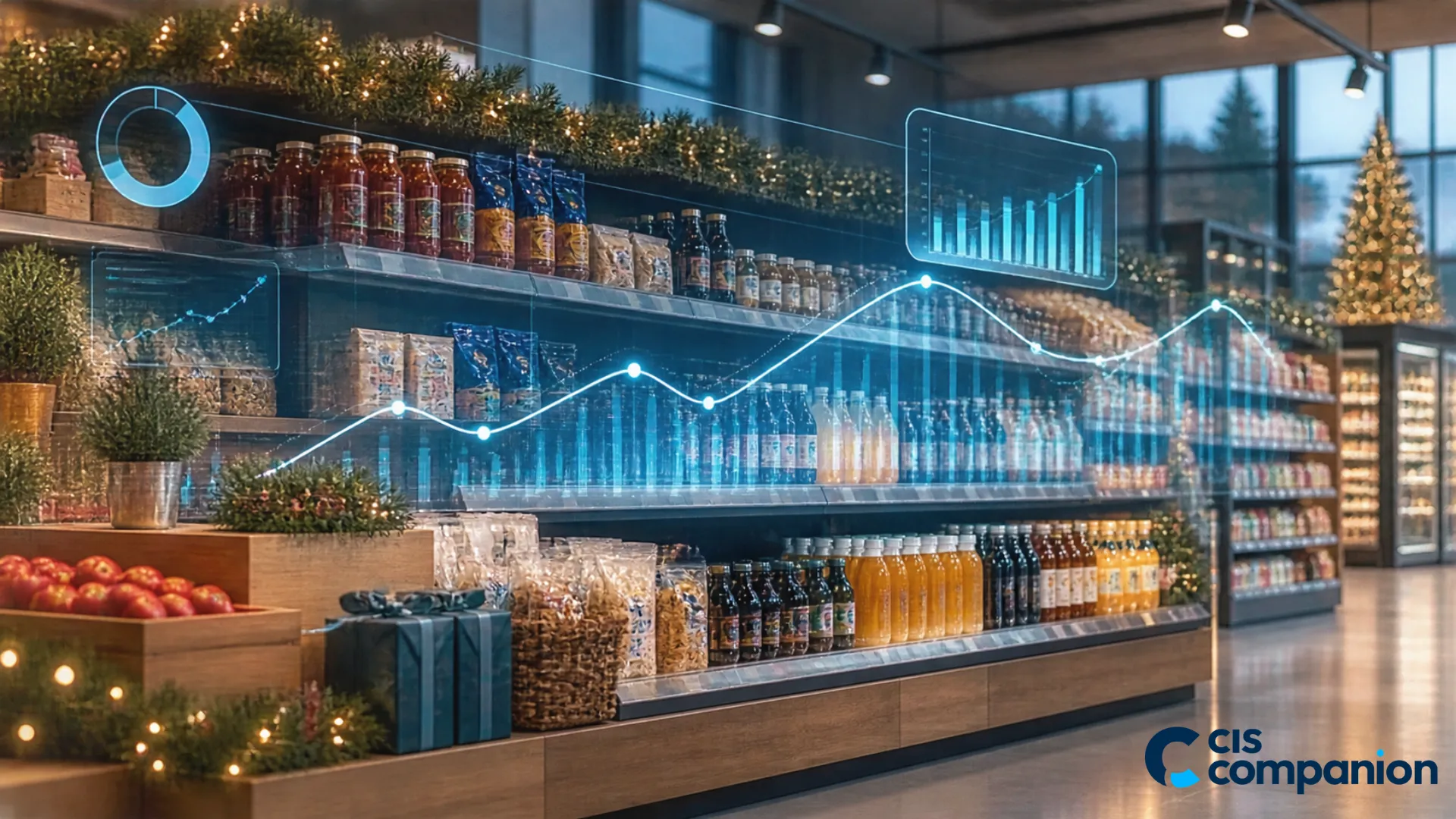
The holiday season changes consumer habits. Some products suddenly become more popular, volumes fluctuate, schedules change, and demand can vary considerably from one week to the next, or even from one point of sale to another.
For businesses that need to plan inventory and distribution, this period represents much more than an increase in sales. Above all, it is an exercise in anticipation.
What if data could help provide a clearer picture?
When Usual Patterns Are No Longer Enough
Forecasting demand is never entirely simple. During a period as unique as the holiday season, it becomes even more complex.
A product that sells at a relatively steady pace throughout the year may experience a significant increase in December. Conversely, demand for certain products may temporarily slow down. And these variations are not necessarily the same from one store or territory to another.
There are also very practical realities to consider in the field. With employees taking time off during the holidays, route assignments may change, and a driver or merchandiser may be asked to cover a territory they know less well. They may not have the same knowledge of ordering habits or the specific needs of each point of sale. Demand forecasting can help support these teams by providing recommendations based on available data.
Statutory holidays can also change delivery schedules. For example, if a point of sale is closed on December 25 and no delivery is scheduled for that day, its needs must be anticipated based on the next scheduled delivery. Demand forecasting can take these schedule changes into account to help adjust delivery quantities and maintain adequate inventory levels until the next delivery.
For teams responsible for ordering and distribution, the question then becomes:
How much should be planned to meet demand at the right time, without unnecessarily creating excess inventory or stockouts?
Traditionally, this decision may rely in part on the experience and judgment of teams. This knowledge remains valuable, but it can now be supported by data as an additional source of information to help guide decisions.
Moving from What Happened to What Could Happen
Businesses already accumulate a significant amount of operational data. The challenge is not simply accessing that data, but transforming it into useful information that can support decision-making.
This is where demand forecasting comes into play.
By analyzing available data and consumption patterns, artificial intelligence can help identify trends and generate predictions that support teams in their decision-making.
With CIS Companion AI, these predictions are based on real data to help distributors determine which products to deliver, in what quantities and to which locations. The solution can also analyze consumption patterns and local data to recommend an assortment tailored to each point of sale.
The objective is not to replace the experience of your teams, but to give them more information to guide their decisions.
Better Forecasting for Better Distribution
Better anticipation of demand can have an impact at several levels.
When a business can better determine where and when a product will be needed, it can work to:
- reduce stockouts;
- limit excess inventory and returns;
- reduce waste;
- improve product availability;
- make the work of teams responsible for ordering and distribution easier.
These are also some of the benefits CIS Companion AI aims to deliver by using demand forecasting and assortment optimization to support decisions made at the store level.
During the holiday season, this ability to anticipate demand becomes particularly relevant. Between fluctuations in demand, changes in route assignments and delivery schedules affected by statutory holidays, teams must account for more variables than usual. Demand forecasting can provide an additional point of reference to help guide decisions in the field.
Artificial Intelligence as a Decision-Support Tool
Artificial intelligence cannot eliminate the unexpected. A forecast remains a forecast.
Its value lies in its ability to process a volume of information that would be difficult to analyze manually with the same speed and consistency.
For distribution businesses, this means moving from an approach where decisions rely primarily on intuition to one where field experience and data work together.
At CIS, this approach is at the heart of the development of Companion AI. The solution incorporates two key applications of artificial intelligence: order prediction and assortment optimization at the point-of-sale level.
What About After the Holidays?
The holiday season is a particularly relevant example, but variations in demand certainly do not end in December.
Seasons, promotions, local events and evolving consumer habits are among the many factors that can influence what customers will need tomorrow.
Throughout the year, the challenge remains the same: better understand your data to better anticipate demand.
Because ultimately, good forecasting aims to achieve something very concrete:
the right product, in the right quantity, at the right place, at the right time.
This is also the principle at the heart of the CIS Companion AI approach.